
Click anywhere or press any key to enter
A prefatory note from Professor Alistair J. Wetherby, F.R.S., F.Z.S.
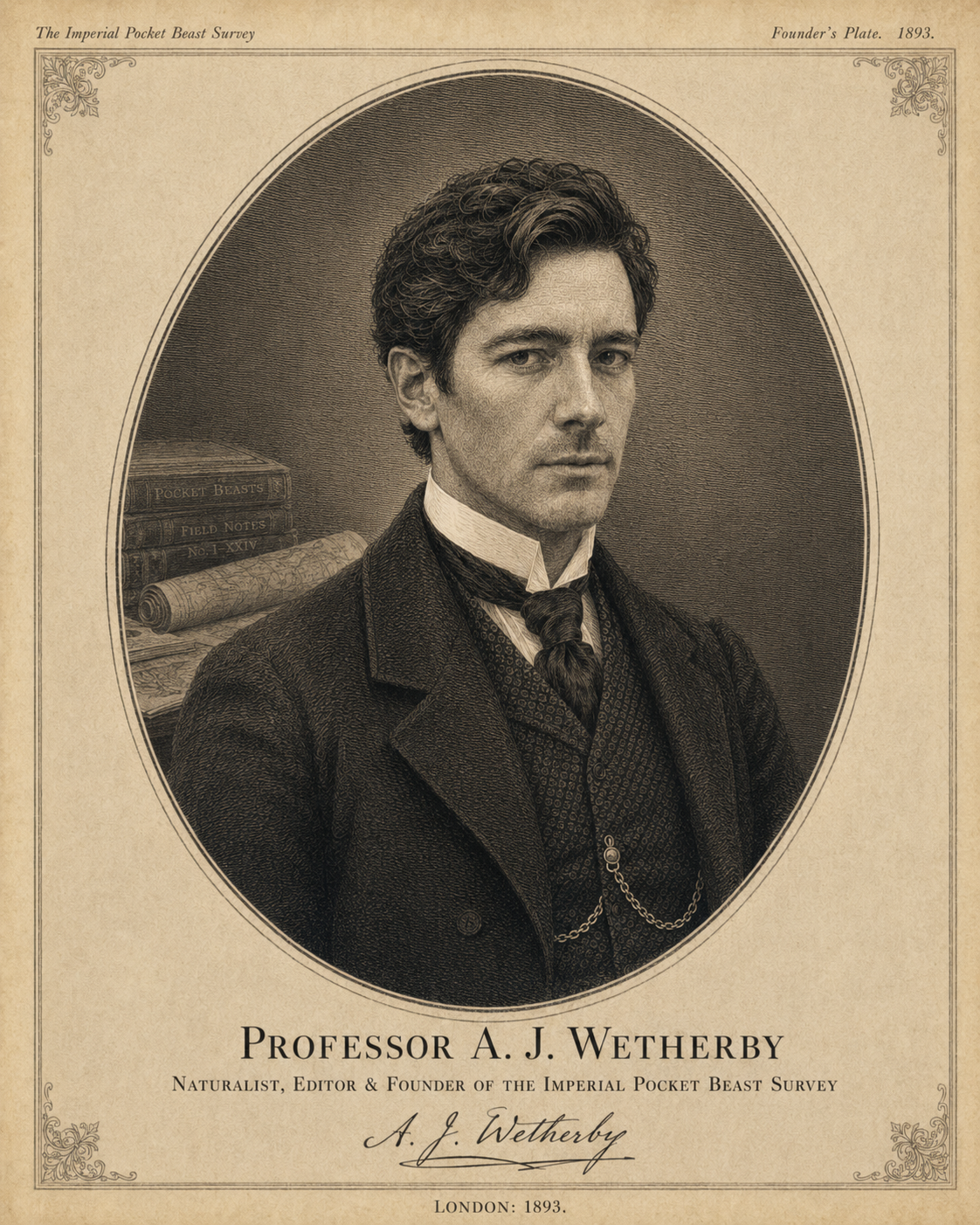
In the course of the Empire's great natural-philosophical enterprise, from the harbour mouths of Bombay to the wire-crossed plains of the Cape and from the hills of Assam to the furthest stations of the Sudan, Her Majesty's naturalists and men of science have brought to light wonders undreamt of in former ages. Among the most remarkable: a class of creature, hitherto unknown to European science, possessed of extraordinary temperament, singular loyalty to human companions, and faculties which would astonish even the most seasoned Fellow of this Society.
These are the Pocket Beasts of the Empire, so called on account of their marked affinity for human society, their compact form in early life, and their singular habit of devotion to a single keeper. They have been observed in engine sheds and boiler rooms, in naval harbours and telegraph stations, upon the heathered uplands of the British Isles and in the most distant provinces of the Crown.
The present series represents five years' painstaking classification, conducted by the Wetherby Institute under the auspices of the Royal Society of Natural Imperial Enquiry and executed by the finest natural history illustrators of the age. Each specimen is entered in the Imperial Specimen Registry at the Institute's rooms in Paternoster Row; each card presents one specimen in faithful illustration, together with its designation, order, natural province, and habits of development.
We commend this series to parents, schoolmasters, and guardians as an amusement both improving and entirely respectable: one in which geography shall be learned, the spirit of observation cultivated, and the instinct of the naturalist kindled in every young collector who opens these pages.
Plate I of IV: Eighteen Founding Specimens, Classified under Six Imperial Lines
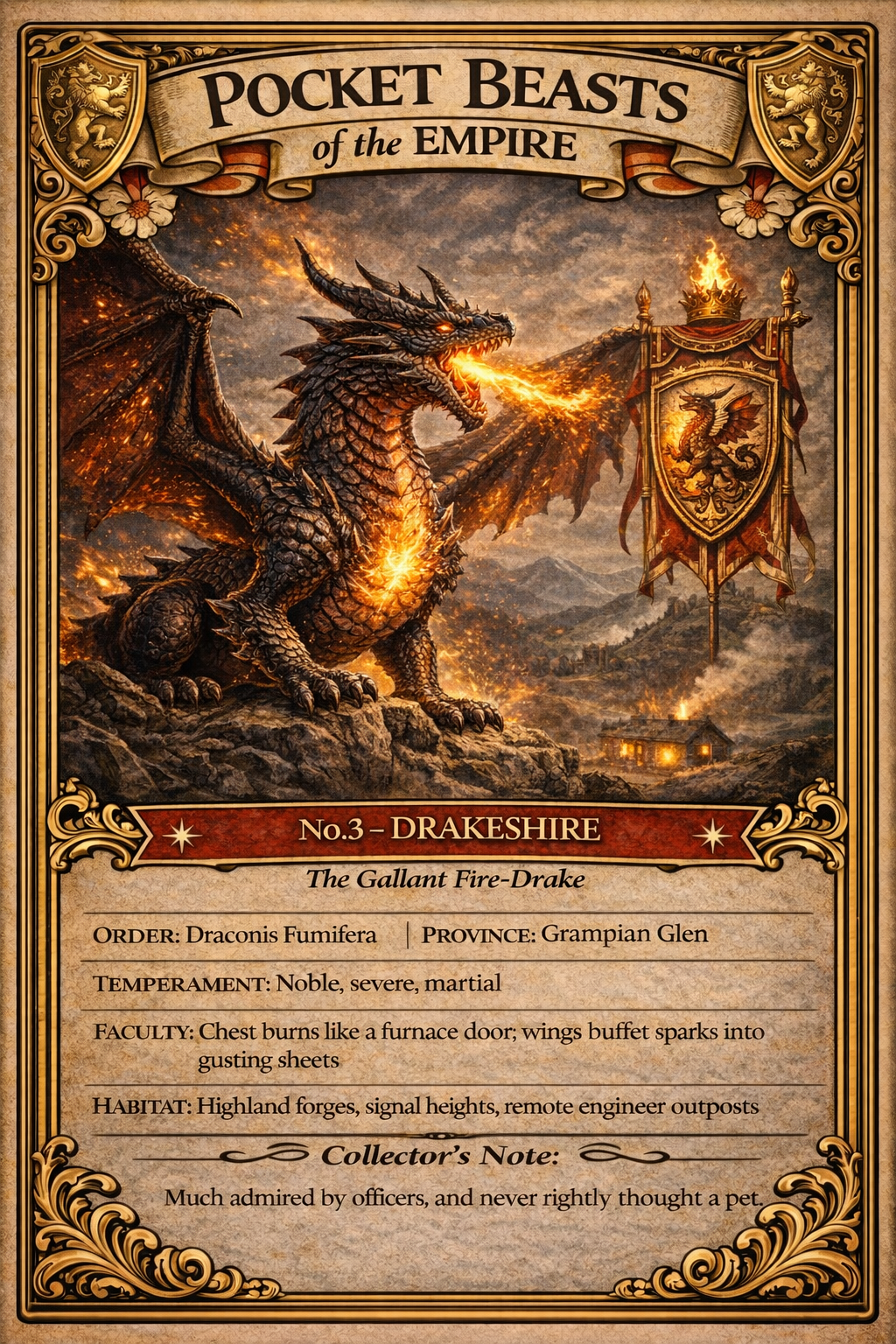
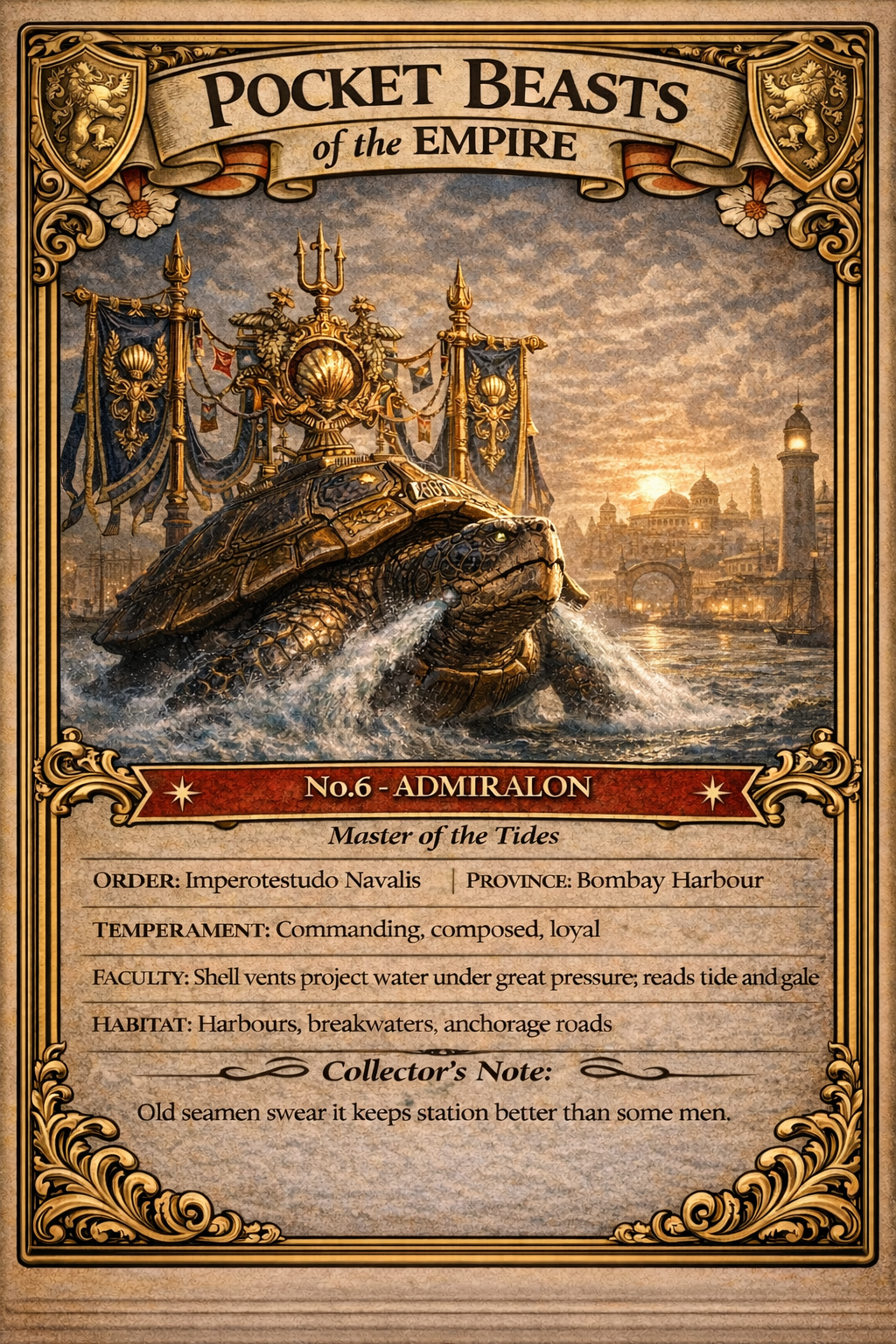
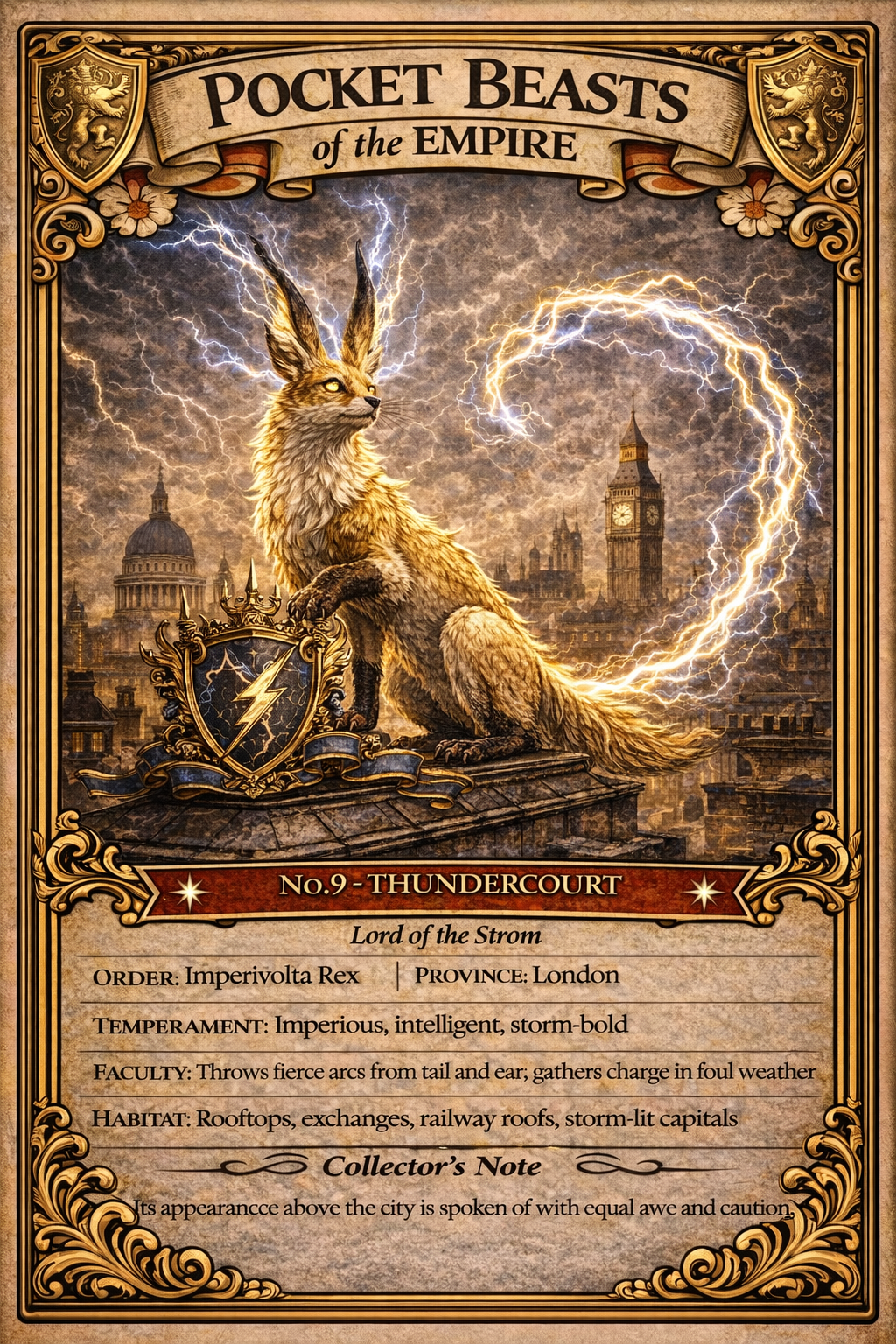

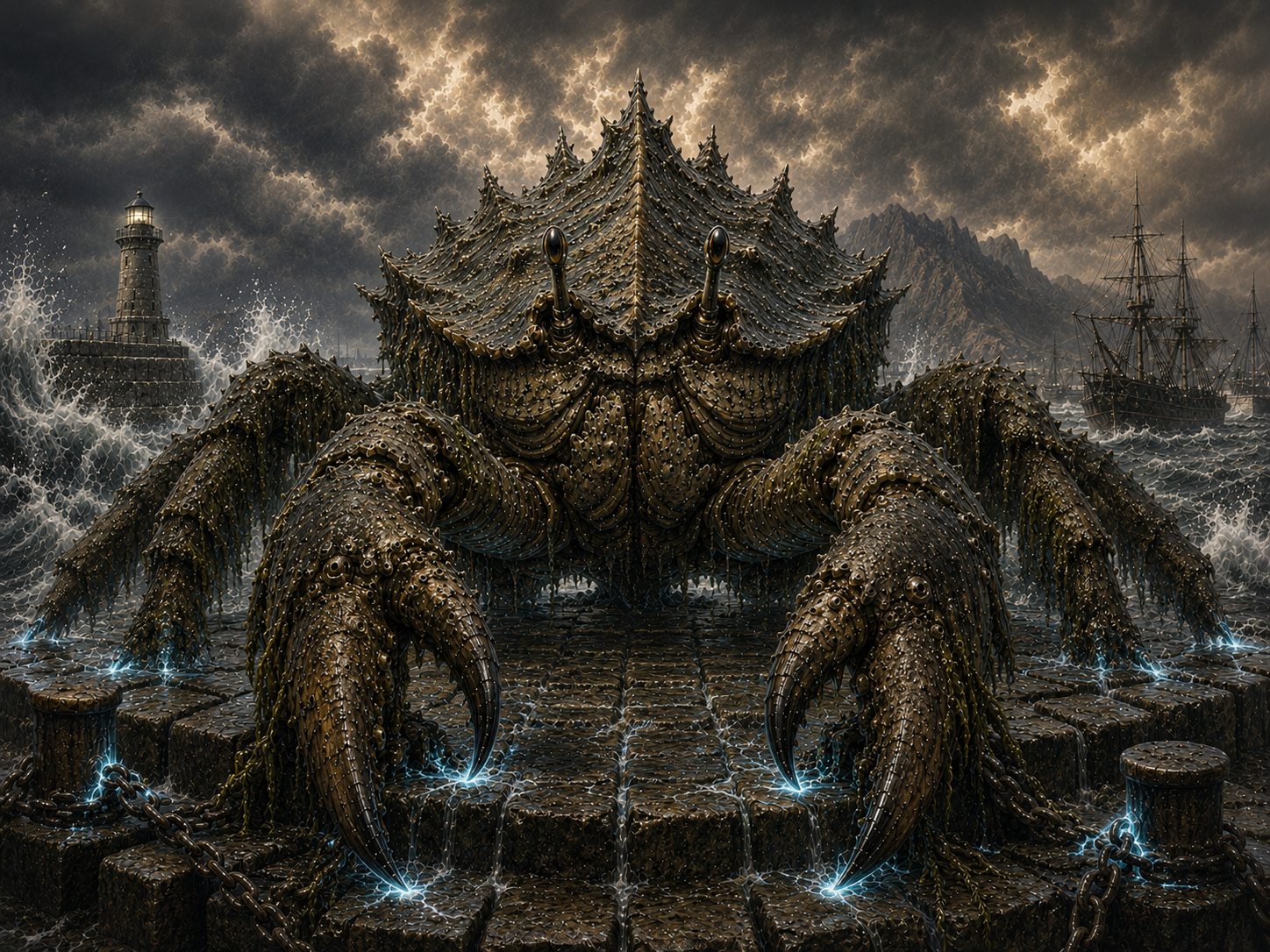
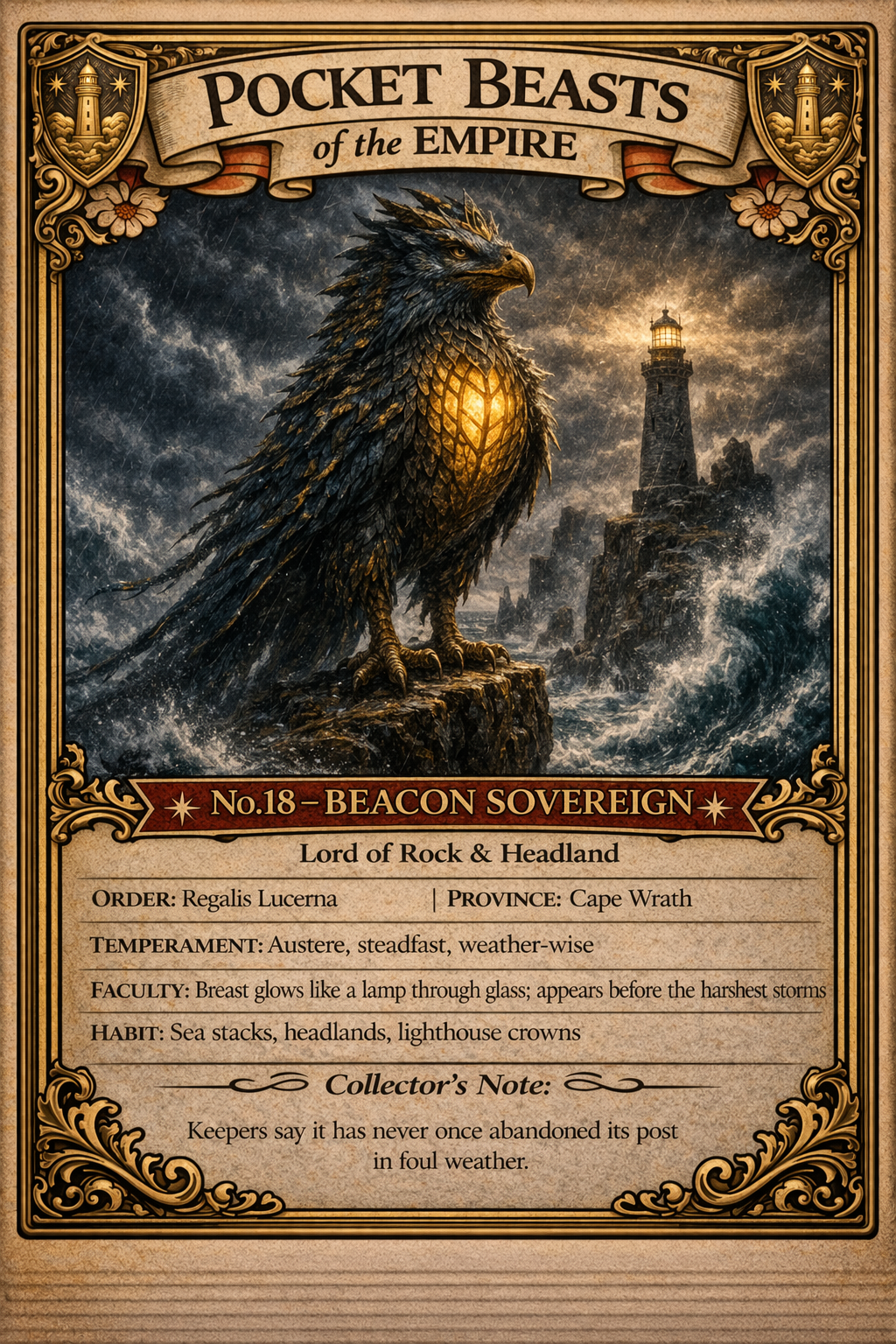
Sovereign Specimens, one per Imperial Line, from Professor Wetherby's Pocket Beasts of the Empire, Plate I, Series the First.
Natural History Studio of the Wetherby Press, London, MDCCCXCIII.
Extended particulars of each specimen are reserved for holders of the Register — accessible in the Cabinet upon receipt of your set.
500 numbered sets · The Register closes when the run is subscribed
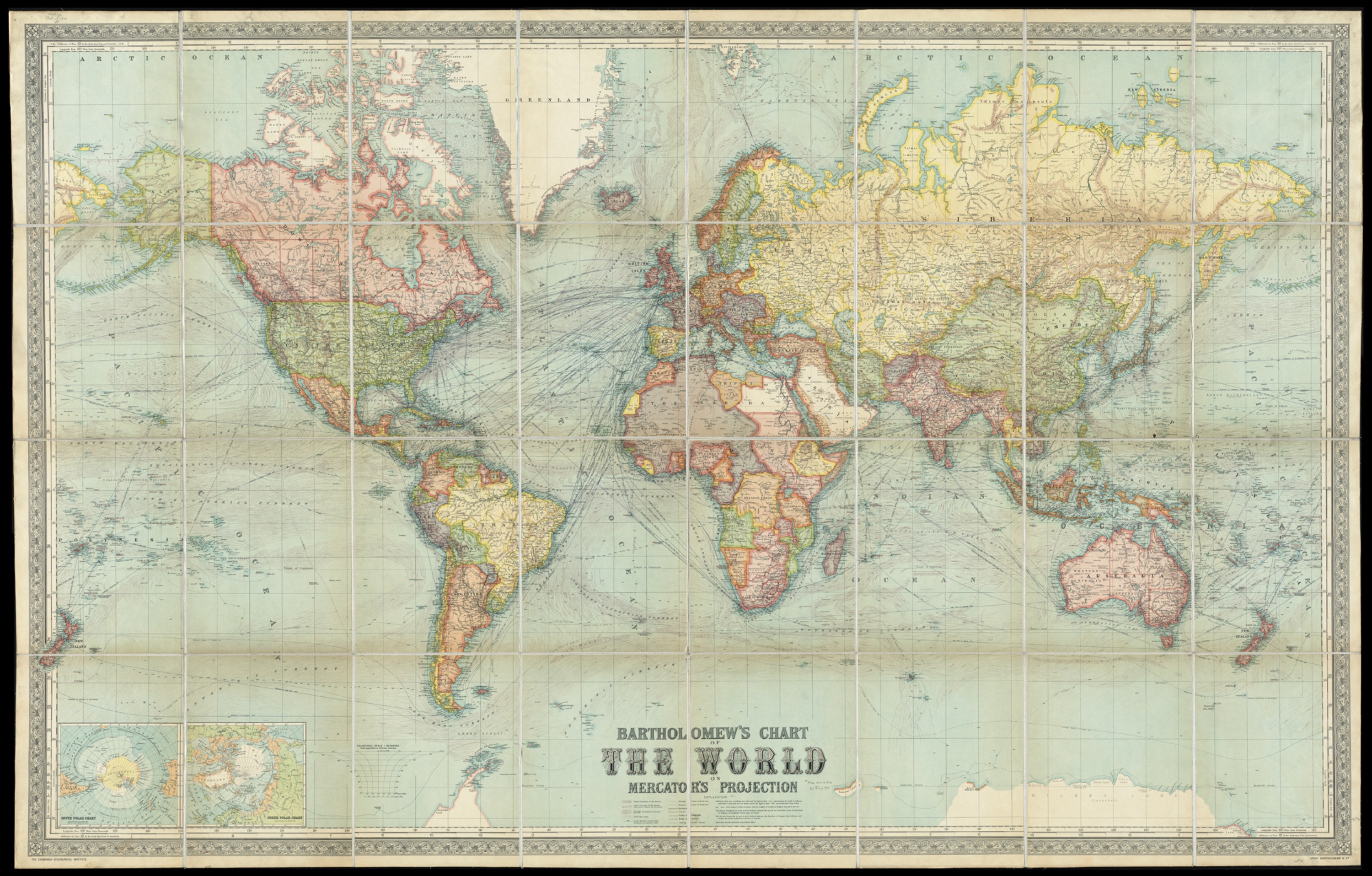
Known Provinces of Observation · Further Sightings Reported in the Farthest Stations of the Crown
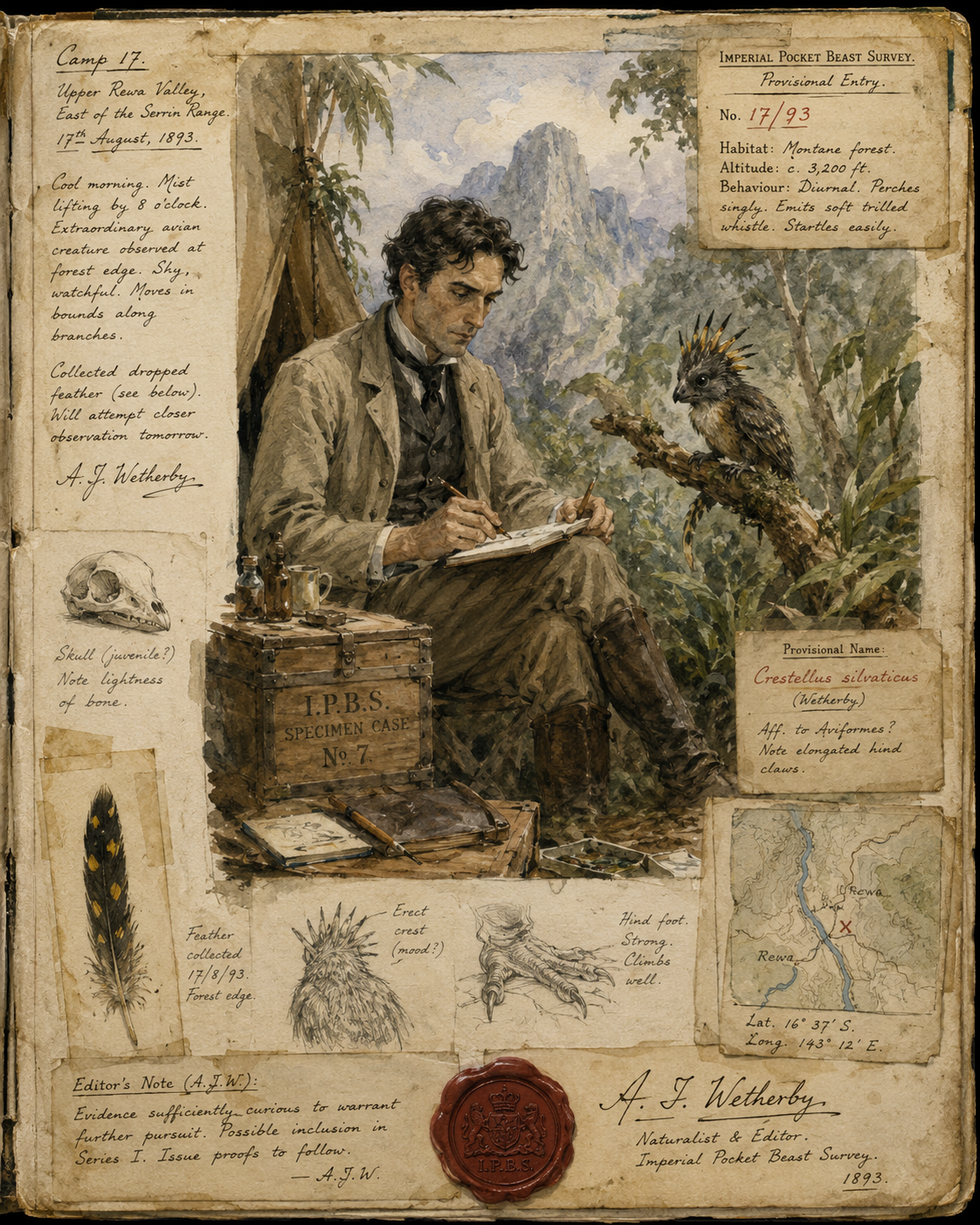
Eighteen Founding Specimens, Issued by Serial Subscription in the Victorian Tradition
Pocket Beasts of the Empire is issued in Plates, after the manner of Victorian serial natural history publications. Plate I, eighteen Founding Specimens across Six Imperial Lines, is the first of four planned Plates. Each subsequent Plate shall be opened for circulation only when sufficient patronage justifies a proper print run.
Subscribers entered in the First Register shall have precedence in all future issues and receive first notice when Plate II is opened for circulation. The Register closes when the inaugural print run is subscribed.
Certain specimens, designated Sovereign Plates in the Imperial Specimen Registry, present with a peculiar iridescent quality attributed by the Institute to each creature's natural electrostatic discharge. Six Sovereign Plates are issued per Plate, one per Imperial Line, and are available exclusively within the Imperial Subscriber's Dispatch.
"An instructive amusement for the nursery and schoolroom alike. Encourages geographical curiosity, habits of observation, and the spirit of imperial enquiry in the young collector."
Imagined Correspondence from the World of the Survey, London, 1893 — a Work of Fiction
"My sons are entirely consumed with the Fire Line. The eldest has declared Drakeshire the finest creature in all natural history, and the younger refuses to be parted from his Cindersnap even at table. Their geography has improved beyond all expectation."
"I have served at stations from Aden to Rangoon and I find the Admiralon to be a most faithful likeness of a creature I myself encountered in the harbour at Colombo in eighty-eight. The scientific notation is admirably precise."
"The Sparkit card has become a fixture of my schoolroom. Three of my pupils have set about corresponding with cousins at other schools simply in order to acquire duplicate cards for trading. I can think of no finer proof of an educational amusement's success."
"The cards are of fine manufacture and the illustrations altogether superior to anything I have seen in the cigarette series. Professor Wetherby is to be congratulated upon a most worthy contribution to natural science."
The letters above are period writings composed for the world of the Survey. They are works of imagination, not reviews from customers.
It is my considerable honour to announce the publication of Pocket Beasts of the Empire — Plate I of Four, the inaugural fascicle of what I trust shall prove the most celebrated series of natural history cards yet issued under a British imprint. Five years in the making; five years of correspondence with surveyors, naval officers, telegraph engineers, and station-masters from Aden to Hong Kong; five years of the most painstaking illustration, classification, and annotation — and all is now brought to completion. The first eighteen specimens are prepared for distribution.
The series is designed upon the model of the great Victorian natural history journals: issued in Plates, by subscription, to those who have placed their names in the Register. Plate I contains the Founding Eighteen. Plates II, III, and IV shall follow at quarterly intervals, each introducing a further tranche of specimens and, for those in the Subscriber's Register, exclusive materials available by no other means. Four Plates complete the set — a compendium worthy of the finest schoolroom or gentleman's library.
The inaugural print run is strictly limited to five hundred sets. Those who enter the Register first shall hold precedence in the allocation of subsequent Plates, and shall be recorded by name in the First Edition colophon — a distinction which shall not diminish in interest as the years advance. The Register closes when the run is subscribed.
I commend these creatures to your household without reservation. The young collector who makes their acquaintance shall find geography, natural science, and the habits of patient observation all considerably improved in the most diverting manner that art and science have yet contrived.
Enter the Register, receive Plate I, and secure precedence when the Professor's subsequent Plates are opened for circulation.
Plate I of IV — Inaugural Print Run — Strictly Limited to 500 Sets
Your Name is Entered in the Register
Payment received. Your dispatch shall be prepared upon completion of the inaugural print run and conveyed to you thereafter. You shall receive advance notice by telegraphic address before your set departs.
A receipt has been issued to your telegraphic address.
Not entering the Register today?
Enter your telegraphic address and you shall receive word the moment Plate II is opened for circulation, with first precedence reserved for those already in the Register.
Noted in the Dispatch List
You shall be among the first to receive word when Plate II opens for circulation.
Let it be recorded that
is this day entered in the Register of Subscribers to
Pocket Beasts of the Empire, Plate I of IV,
by way of the Naturalist's Dispatch.
The Subscriber's Number, among the five hundred, shall be assigned in strict order of entry and shall accompany the dispatch. The reserved particulars of the Registry, hitherto sealed, now stand open to the Subscriber within the Professor's Cabinet.